

Choosing the right baler is a critical capital investment that directly impacts your operational efficiency, labor costs, and profitability. Choosing a baler generally depends on two main configurations: horizontal and vertical.
While both can compress waste materials, their design objectives, scale of operations, workflows, and business environments differ significantly. An inappropriate choice can lead to production bottlenecks, excessive labor costs, or underutilized assets.
Understanding the Basics of Baling Equipment
What is a horizontal baler, and how does it work?
Horizontal balers use different axes to compress material from the side. Typically, waste material is loaded into a large hopper at one end and then dropped into a silo. A hydraulic ram then moves horizontally, pushing the material into the baling chamber and against the solid end walls.
As more material is added, the baler recycles, forming a dense bundle that is then pushed into the silo. The final bundle is automatically tied by an automated tying system at the end of the channel and then cut.
The entire process is designed for continuous throughput, making it ideal for high-volume applications, as detailed in a study on horizontal machine performance.
Installation Footprint and Space Requirements
When floor space is limited, a vertical baler is a wise choice. Its compact, tall design typically occupies only a few square meters. However, it requires a large vertical footprint to accommodate the movement of the top bar and the loading process.
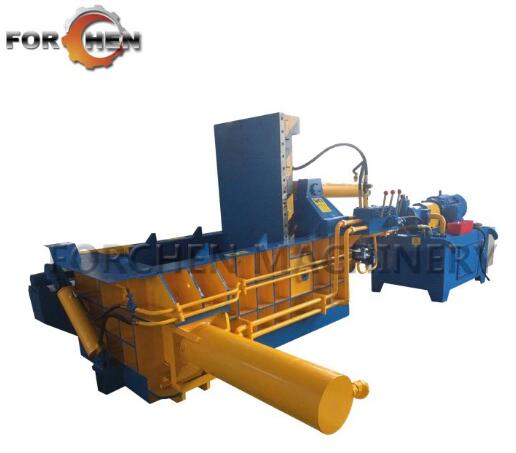
A horizontal aluminum baler requires a larger linear footprint. You need to consider not only the machine itself (which can be over 10 meters in length), but also the infeed conveyor system and the outfeed area for bale accumulation and removal.
Processing Volume, Throughput, and Operating Speed
This is arguably the most important difference. Vertical balers are batch-feed machines suitable for small streams of waste material. The baling process stops while the operator loads and ties the bales.
A plant may only produce a small number of bales per day. In contrast, horizontal aluminum balers are designed for high throughput. They process material continuously, with cycle times measured in seconds, not minutes.
For example, our horizontal aluminum baler can be configured with up to 160 tons of pressure and can process several tons of material per hour, making it a mainstay of any serious recycling operation.
Material Feeding Methods: Manual vs. Automatic
Horizontal aluminum balers are designed to integrate into automated workflows. They are typically fed by conveyors, tippers, or pneumatic systems, continuously feeding material into the hopper. This automation minimizes manual operation, improves safety, and allows the baler to operate uninterrupted and at maximum capacity.
Bale Size, Density, and Consistency
Horizontal aluminum balers produce heavier, denser, and more uniformly sized bales than vertical balers. The powerful pressing force and channel design make bales ideal for truck loading, allowing you to ship the maximum legal weight and minimize freight costs.
Choosing the Right Baler for Your Operational Needs
After identifying the technical differences, the decision becomes matching the machine's capabilities to your specific operating environment, material types, and business scale.
If you produce less than 20-30 tons of a single material (such as cardboard) per month, and your primary goal is to improve site management and avoid landfill fees, a vertical baler is a cost-effective and practical solution.
When a horizontal aluminum baler is the best choice
A horizontal baler is essential for any site that handles large volumes of recyclable materials. This includes material recovery facilities (MRFs), large distribution centers, printing companies, packaging manufacturers, and municipal recycling stations.
If your operations are measured in tons per hour rather than bales per day, and efficiency, automation, and minimizing labor costs are your primary drivers, investing in a high-performance horizontal aluminum baler is essential. It seamlessly integrates into your sorting or production line and is a cornerstone of industrial recycling.


