

The alligator shearing machine holds significant importance in the cable recycling process for several key reasons, primarily centered around its ability to efficiently and safely prepare cables for subsequent processing stages aimed at recovering valuable metals like copper and aluminum. Here's a detailed breakdown of its importance:
Efficient Size Reduction: Cables, especially industrial and telecommunication cables, often come in long, bulky reels or bundles. These large formats are unsuitable for direct feeding into granulators or other downstream processing equipment.
Alligator shearing machines act as a crucial first step by cutting these long cables into shorter, more manageable segments. This size reduction optimizes the feeding process into subsequent machinery, ensuring a continuous and efficient flow of material. Without this initial cutting, the recycling process would be significantly slower and more labor-intensive, requiring manual handling of unwieldy lengths.
Facilitating Insulation Removal: Many cables have a thick layer of insulation made of plastic, rubber, or other materials. While alligator shears don't directly remove this insulation, by cutting the cables into smaller pieces, they expose more of the cable ends.
This increased surface area and the clean cuts created by the shear make it easier for downstream equipment like cable strippers or granulators to effectively remove the insulation and access the inner metal conductors. The clean cuts prevent tangling and allow for a more uniform feed into stripping or granulation machines, improving their efficiency.
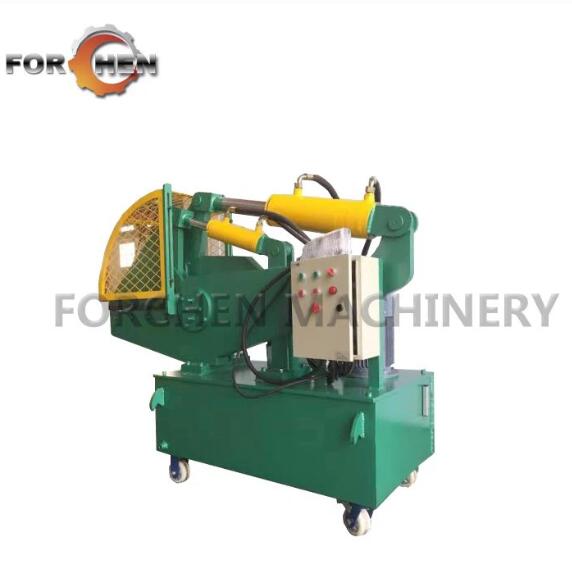
Separation of Composite Cables: Some cables contain multiple layers of different materials, including steel or lead armoring for protection. Alligator shearing machines possess the power to cut through these composite structures, separating the various components.
This is particularly important for preparing cables for granulation, where different materials need to be liberated from each other for effective separation and recovery. The shear can break down the complex cable structure into smaller, less integrated pieces, making the subsequent separation of metals and plastics more feasible.
Pre-processing for Granulation: Granulation is a common method for recovering copper and aluminum from insulated cables. This process involves shredding the cables into small granules and then using various separation techniques (like air separation or magnetic separation) to separate the metal from the plastic.
Alligator shears play a vital role in pre-processing cables for granulation by reducing them to a suitable length that can be efficiently fed into the granulator. Consistent and appropriately sized input material ensures optimal performance of the granulator and a higher quality of recovered metal granules.
Handling Diverse Cable Types: The cable recycling industry deals with a wide variety of cable types, differing in thickness, material composition, and the presence of shielding or armoring. They are versatile enough to handle this diversity.
Their powerful hydraulic jaws can cut through thin household wires as well as thick industrial power cables and armored telecommunication cables, making them a flexible and essential tool for recyclers dealing with mixed cable streams.
Enhancing Safety: Manually handling and trying to cut large, tangled bundles of cables can be dangerous. Alligator shearing machines provide a safer and more controlled method for reducing cable size. Equipped with safety features like blade guards and foot pedal operation, they minimize the risk of injury to workers compared to manual cutting methods or attempting to feed oversized cables directly into other machinery.
Increasing Efficiency and Throughput: By automating the initial size reduction stage, alligator shears significantly increase the overall efficiency and throughput of the cable recycling process.
They can process a large volume of cables relatively quickly, preparing a consistent stream of material for downstream equipment. This increased efficiency translates to higher processing capacities and improved profitability for recycling operations.
Improving the Quality of Recovered Materials: Proper pre-processing with an alligator shearing machine can contribute to a higher quality of recovered metals. By creating clean cuts and facilitating better separation of insulation and other non-metallic components, the risk of contamination in the final metal product is reduced. This higher-quality metal scrap is more valuable and readily usable as a secondary raw material.


